
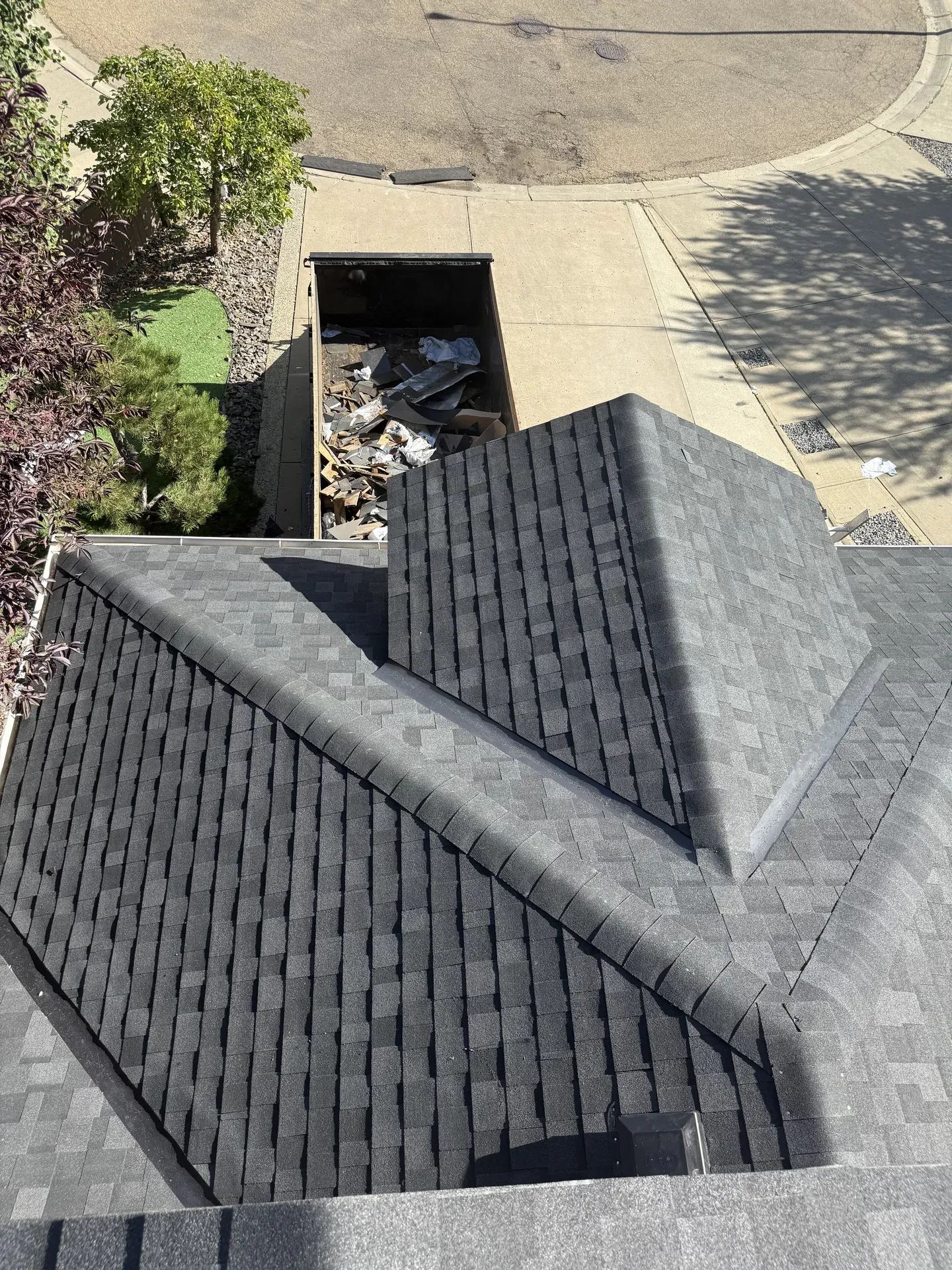
Roof replacement cost in Edmonton,
2026 pricing guide.
Real price ranges by home size and material, what actually moves the number, and how to spot an incomplete quote.
Free Estimate · No Obligation
Want the number for your own roof?
Priced on your actual Edmonton roof, not an average. No obligation, and we reply the same day.
Ranges are useful for budgeting, but they are not a quote. Tell us about your roof and we will put a real figure in writing for your Edmonton home. No obligation, no sales pitch, and we get back to you the same day.
Or call (780) 937-1184Most Edmonton roof replacements land between $9,000 and $18,000 installed with architectural asphalt shingles, including full tear-off, materials, labour and disposal. A small bungalow can start near $7,500. Large or cut-up rooflines, and premium systems like Class 4 or metal, run from $16,000 to $55,000.
The Edmonton average across all home sizes in 2026 sits near $11,500, and material pricing is running roughly 5 percent above last year. Every roof is different, which is why we quote line by line, but the breakdown below will tell you roughly where your home lands before anyone comes out.
Cost by Home Size
What size does to the number
Size is the single biggest driver of price. Everything below assumes architectural asphalt shingles, a full tear-off, and typical complexity, with materials, labour and disposal included.
One thing to settle before you budget: your roof is bigger than your floor plan. Pitch and overhangs add area, so a 1,200 square foot bungalow footprint usually carries somewhere around 1,500 to 1,700 square feet of actual roof surface. A steeper roof adds more again.
Small bungalows, anything up to roughly 1,500 square feet of roof, run $7,500 to $11,500. These are the simplest roofs we do: single storey, walkable pitch, not many penetrations to flash around. Most are stripped and reshingled inside a day.
An average bungalow carries around 1,500 to 2,000 square feet of roof and lands between $9,000 and $14,000. This is the most common quote we write in Edmonton. Where a house falls inside that range usually has less to do with square footage than with how many vents, skylights and chimneys are up there, because every one of those is flashing work done by hand.
Two-storey homes typically carry 1,800 to 2,400 square feet of roof and cost $11,500 to $18,000. The extra money is not only the area. It is the height: more staging, more fall-protection setup, slower material handling, and a longer trip for every bundle that goes up and every square of old shingle that comes down.
Large or cut-up rooflines, meaning 2,500 square feet and up or anything with a steep pitch and a lot of valleys and dormers, start around $16,000 and can pass $28,000 once premium materials are involved. Worth knowing: a cut-up roof on a 2,000 square foot house can cost more than a simple roof on a 2,800 square foot one. Area is easy. Detail is not.
Within every one of those bands the same rule holds. Simple, walkable gable roofs land near the bottom. Steep pitches, multiple storeys, dormers, valleys and skylights push toward the top.
Cost by Material
What you put on top of it
Material is the second big lever, and the right answer depends on how long you plan to stay, how exposed your roof is, and whether you would rather buy hail protection once than claim for it repeatedly. Totals below assume a typical Edmonton single-family home.
Basic 3-tab shingles run $7,500 to $12,000 installed, about $3.00 to $5.00 per square foot. They save you $2,000 to $4,000 up front and hand back five years of life, because 3-tab realistically gives 15 to 20 years here against 20 to 25 for architectural. We will install them on a rental or a garage if you ask. On a house you actually live in, that saving disappears the first time you replace the roof five years early.
Architectural asphalt is the Edmonton default and what goes on the large majority of the roofs we do: $9,000 to $15,000, roughly $4.50 to $7.00 per square foot, for a realistic 20 to 25 years. We install IKO, Malarkey, BP and GAF systems. Our guide to the best shingles for Edmonton weather compares them honestly, including which lines are genuinely Class 4 and which only look it on the wrapper.
Class 4 impact-resistant shingles cost $12,000 to $18,000, around $5.50 to $9.00 per square foot, and give 25 to 30 years. The upgrade is usually $2,000 to $4,000 over standard architectural, and in the current Alberta insurance market it is the one we point most homeowners toward. Most insurers here discount the dwelling portion of your premium by 15 to 25 percent for an impact-rated roof, and more of them are tying their best hail terms to one every year.
Designer, composite and rubber systems sit at $15,000 to $25,000, or $7.00 per square foot and up, with 30 to 50 years of service. These make sense on a house with the architecture to carry them, and on roofs where the owner is simply done thinking about it.
Standing seam metal is the long game at $25,000 to $55,000, roughly $9 to $16 per square foot, for 40 to 50 years. It sheds snow, shrugs off freeze-thaw, and can outlast the mortgage. The up-front number is close to double an asphalt roof, which is why it makes real sense on a forever home and rarely makes sense on a five-year hold.
Per Square Foot
The number that keeps quotes honest
Roofers price whole projects rather than squares of shingles, but per square foot maths is the fastest way to sanity-check a quote against the ranges above. Divide the quoted total by your roof area, not your floor area, and see where it lands. Architectural asphalt, the Edmonton benchmark, should come out around $4.50 to $7.00 per square foot installed.
The word doing the work there is installed. A legitimate per square foot figure covers tear-off, underlayment and membrane, new flashings, labour and disposal. It is not the price of shingles, and a quote built only on material cost will always look cheaper than one that includes the work.
So if a price comes in dramatically under these ranges, nothing magical has happened. Something has been left out of it, and you generally meet that something halfway through the job, priced as an extra, with your roof already open and very little leverage on your side.
One bit of vocabulary while you are comparing. Roofers talk in squares, and one square is simply 100 square feet of roof. A typical Edmonton bungalow works out to somewhere around 15 to 20 squares, and a two-storey is often 18 to 24. If a quote is priced per square, divide by 100 to get back to the per square foot figures above.
The Line Items
What sits inside the total
Roughly half to sixty percent of a roofing project is labour, which is why two quotes using identical shingles can still sit thousands apart. Here is what the money is actually buying.
Tear-off and disposal is $1,400 to $2,800 on a typical Edmonton home. It should already be inside the number you were quoted rather than turning up as a line at the end. If a quote says nothing about disposal, ask where it went.
Deck sheathing runs $75 to $150 per 4x8 sheet installed. Nobody can tell you how many sheets your roof needs until it is open, which is exactly why the per-sheet price belongs in writing beforehand instead of being negotiated on your driveway with the shingles already off.
Flashings are where a good shingle quietly fails. Chimney flashing done properly, stepped and counter-flashed rather than caulked over, is $350 to $1,000. A skylight is $300 to $800 each with a new kit rather than the old one reused. Step, apron, drip edge and vent boots together run $200 to $600. Reused flashing is the single most common leak on an otherwise sound new roof.
Ventilation correction is $300 to $800 for added exhaust, rafter baffles, or clearing soffit intake that decades of blown-in insulation have packed shut. It is the cheapest genuinely valuable money on the whole project, because poor attic airflow cooks shingles from underneath and voids most manufacturer warranties.
A permit, where one is needed, is $150 to $500. For a straight like-for-like re-shingle in Edmonton, one is not: the City treats that as maintenance.
If the eavestrough, soffit or fascia are tired, price them into the same project. Seamless eavestrough runs $8 to $16 per linear foot for 5-inch and $10 to $18 for 6-inch, and doing it while the access equipment is already up costs meaningfully less than a separate mobilisation later.
Cost Drivers
What actually moves your number
Two houses with the same floor plan on the same street can get quotes thousands of dollars apart. The difference is almost always somewhere in this list.
Pitch, height and cut-up rooflines
Steep pitches need more fall-protection gear and slow everything down, adding 20 to 30 percent to labour past about 8/12. Valleys, dormers, skylights and chimneys each add flashing detail and time. A simple walkable gable is the cheapest roof shape there is.
What the tear-off reveals
Delaminated or rotten sheathing has to be replaced before anything goes back on, typically $75 to $150 per sheet installed. Widespread rot can add $500 to $4,000. A good quote states the per-sheet price up front so the surprise is priced before it happens rather than negotiated on your driveway.
Ventilation corrections
Poor attic ventilation cooks shingles from below and voids manufacturer warranties. Alberta code wants at least 1/300 of insulated ceiling area in net free vent area, split roughly evenly between soffit intake and exhaust near the ridge. Bringing it up to spec usually adds $300 to $800 and is the best money on the whole project.
Access and the yard
A tight infill lot with no bin access, mature trees over the roof, or a house you cannot back a truck up to all add labour. Acreage properties west of the city sometimes add travel. None of it is dramatic on its own; together it moves a quote.
When you book it
Edmonton roofing demand is wildly seasonal. Late fall through early spring commonly prices 10 to 15 percent below peak summer, and a bad hail week firms prices up across the whole city overnight.
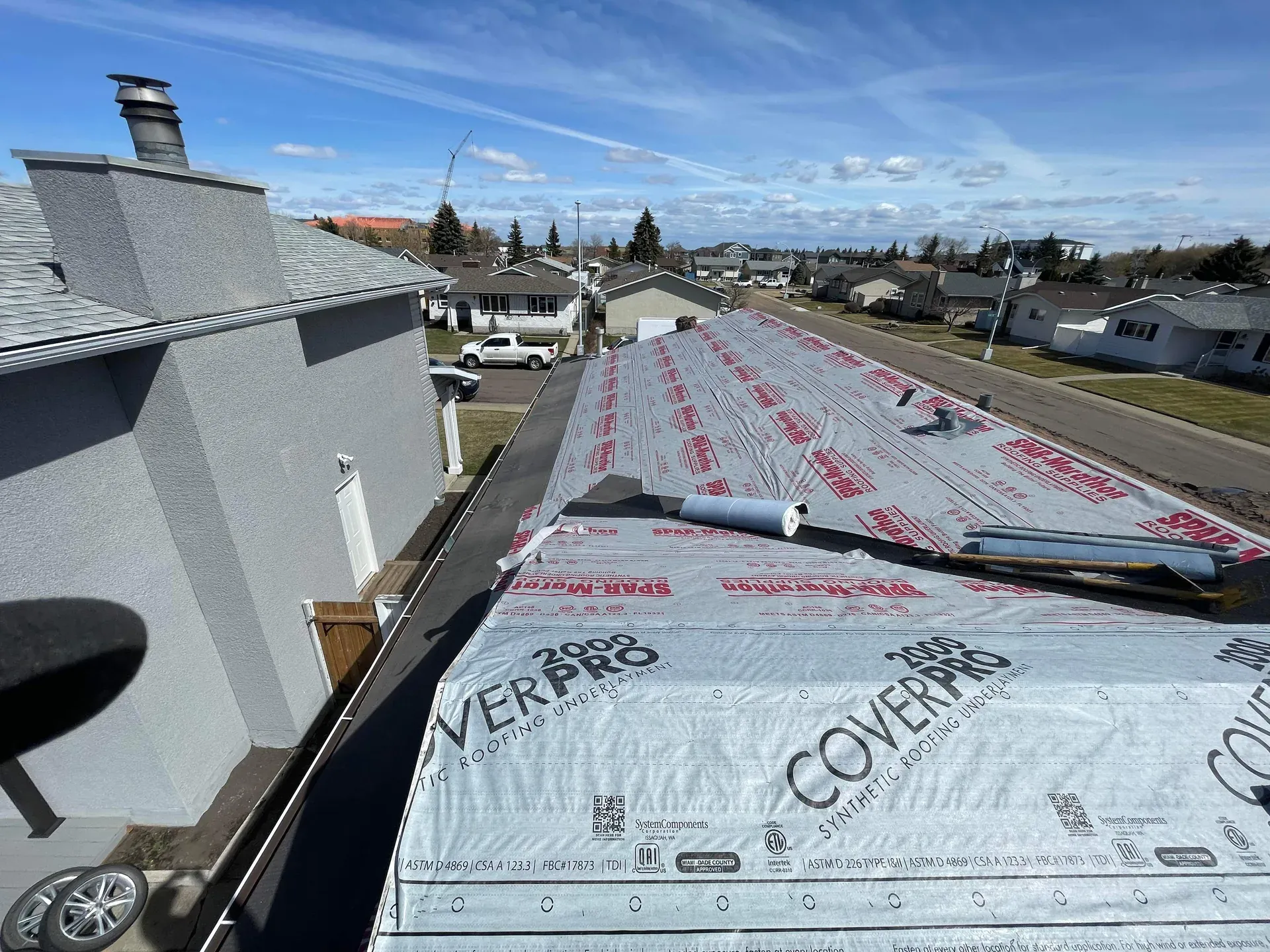
Skip the estimating. Get your actual number.
Free Written QuoteLocal Context
Why Edmonton roofs cost what they cost
National cost articles consistently underprice this market, because they average in cities that never see what our roofs see. A roof built to the bare minimum here fails early, and the specification that survives an Edmonton decade costs more than the specification that survives a Vancouver one.
Freeze-thaw is the quiet one. A roof that swings from minus 25 to plus 4 and back inside a week works at every seal strip, every fastener, and every bond between shingle layers. We do that repeatedly through winter and shoulder season. It is why ice and water shield at the eaves and valleys is standard on every roof we install rather than an upsell line, and why cheap felt underlayment is a false economy.
Snow load and ice. Roughly 127 centimetres of snow a year, with measurable cover on the ground about 133 days in an average winter. The bottom three feet of an Edmonton roof takes punishment the rest of it never sees, which is exactly where ice dams form.
Storms are not just a Calgary story. The Insurance Bureau of Canada put insured damage from Edmonton-area storms at about $230 million between May and July of 2026: roughly $80 million from the late-May and early-June flooding and about $150 million from the June 20 to 21 system, with mid-July claims still being counted. June 2026 was also the wettest June in Edmonton's recorded history at 244 millimetres, breaking a record set in 1914.
And prairie sun. Long summer days drive the volatile oils out of asphalt and the shingle gets brittle. It is why a "30-year" shingle realistically gives 20 to 25 here, and why attic ventilation matters so much to roof lifespan.
The upside of an honest Edmonton spec is straightforward: done properly once, with a fully detailed replacement, the roof stops being an annual worry. That is the standard our 10-year written workmanship warranty is measured against.
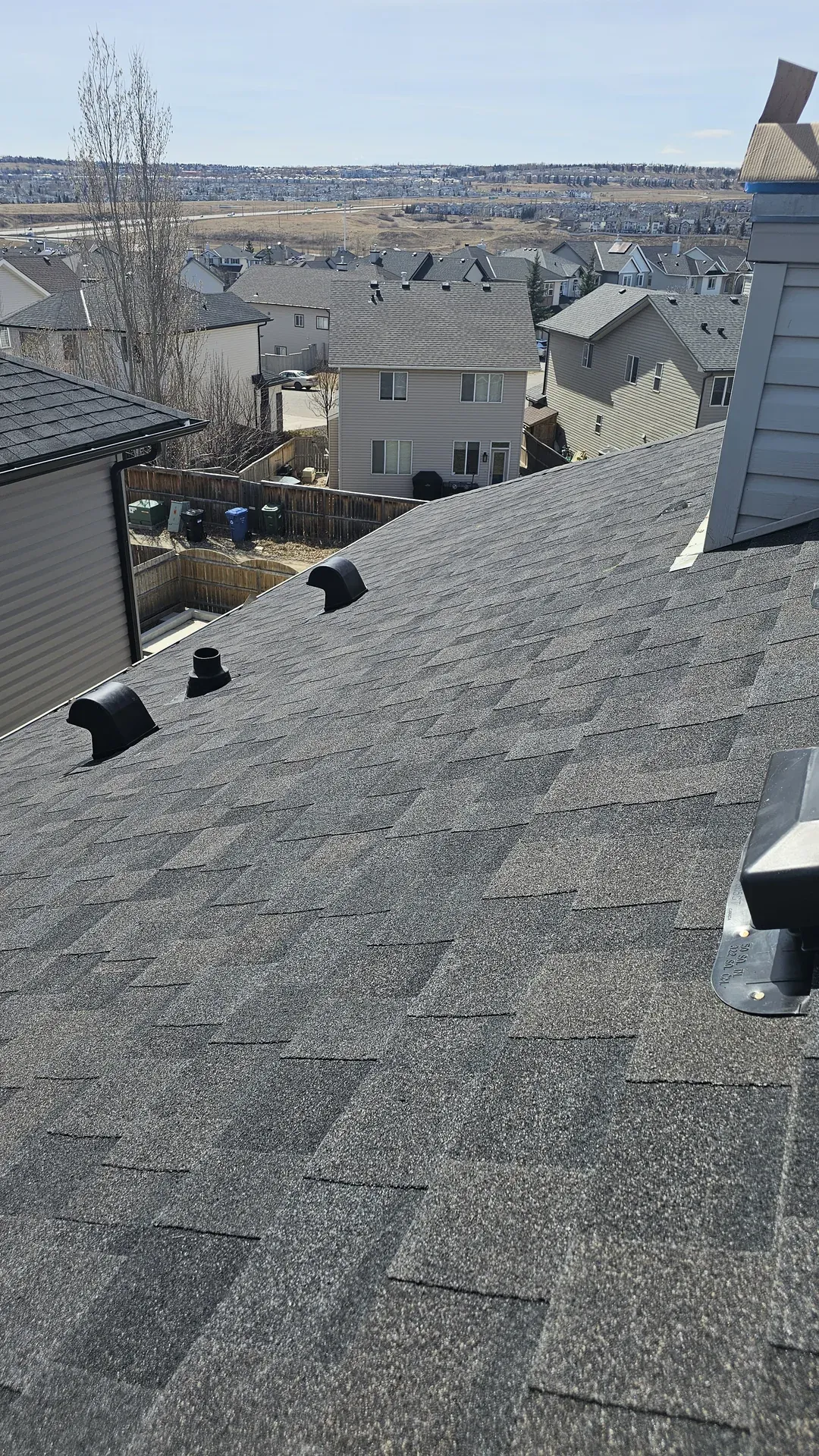
Hail & Insurance
When the roof is a claim, not a cost
If hail or wind damaged your roof, the replacement may be an insurance claim rather than an out-of-pocket expense. The difference is worth thousands, and it turns almost entirely on documentation. Note the storm date, photograph what you can safely see from the ground, and get the roof inspected promptly, because damage documented months later is far easier for an adjuster to dispute.
Three things about the current Alberta market are worth knowing before you make a decision on materials:
Deductibles have climbed. Where $1,000 used to be standard, hail deductibles of $2,500 to $5,000 are now common in this province, and some policies apply a percentage of insured value instead of a flat figure.
Replacement cost is no longer automatic. More insurers are moving older roofs onto actual cash value settlement, which depreciates the payout for the age of the roof, once the roof passes roughly fifteen years. On a fifteen-year-old roof that can be more than half the cheque. Alberta homeowners' premiums rose roughly 392 percent between December 2005 and December 2025, and insurers have responded by pushing risk back onto roofs.
Class 4 is doing real work now. Most Alberta insurers discount the dwelling portion of the premium by 15 to 25 percent for an impact-rated roof, and a growing number tie their best hail terms to one. Set the $2,000 to $4,000 upgrade against an annual discount, a $2,500 to $5,000 deductible avoided, and the chance of staying on replacement cost coverage, and the maths has changed considerably in the last few years.
We inspect suspected hail damage for free, photograph and measure it, and give you an honest read on whether a claim is justified, whether you hire us or not. Our full guide to hail damage and insurance claims in Edmonton walks through the whole process. If it turns out to be ordinary wear rather than storm damage, we will tell you that too, because a denied claim helps nobody.
Spending Well
Sensible ways to keep the cost down
Confirm you actually need a replacement. If the roof has good years left, a repair at $450 to $1,500 beats a five-figure replacement. We tell people straight when a repair is enough, even though the replacement would pay us more. It has cost us jobs and earned us referrals.
Book outside the rush. Get the inspection and quote in late winter, book the install for late August through October. That pairs off-season pricing with the best installation weather of the year. Our guide to the best time of year to replace a roof in Edmonton explains why that window wins.
Bundle the exterior work. If the eavestrough, soffit or fascia are near the end, do them with the roof. The access equipment is already up and the crew is already there.
Spend where it compounds. Class 4 shingles earn an insurance discount every year you own the house. Fixing attic ventilation adds years of shingle life for a few hundred dollars. Cutting the underlayment quality or skipping the ventilation to save a few hundred is how a twenty-five-year roof fails in year fourteen.
Do not do a layover. Shingling over the old roof saves the tear-off cost, hides whatever the deck is doing, traps heat that shortens the new shingles' life, and voids most manufacturer warranties. It is the one saving that reliably costs more later.
FAQ
Roof replacement cost questions.
Most Edmonton roof replacements cost between $9,000 and $18,000 installed with architectural asphalt shingles, including full tear-off, materials, labour and disposal. A small bungalow can come in from around $7,500, and large or cut-up rooflines with premium materials can pass $28,000. The Edmonton average across all home sizes in 2026 sits near $11,500.
In Edmonton in 2026, architectural asphalt shingles run roughly $4.50 to $7.00 per square foot of roof area installed. Basic 3-tab runs $3.00 to $5.00, Class 4 impact-resistant shingles run $5.50 to $9.00, and metal runs about $9 to $16. Those figures include tear-off, underlayment, membrane, flashings, labour and disposal, not just the shingles.
No, and this trips up a lot of budgeting. Roof area is always larger than floor area because of pitch and overhangs. A 1,200 square foot bungalow footprint typically carries somewhere around 1,500 to 1,700 square feet of actual roof surface once the slope and eaves are counted. Steeper roofs add more.
Most single-family Edmonton homes are stripped, decked, underlayed and reshingled in one to two working days. Larger homes, steep pitches, or roofs needing significant deck repair can run to three. Weather is the main variable, and a good crew will not shingle onto a wet or frozen deck to save a day.
For a straight like-for-like re-shingle, the City of Edmonton treats the work as maintenance and no building permit is required. A permit is required if the job involves structural or framing alterations, changes to the roof shape or height, repairs following fire or flood damage, or added floor area. Surrounding municipalities follow similar logic. We confirm the requirement for your specific job and handle the application when one is needed.
We do not do layovers and we would not recommend one. Covering old shingles hides deck rot and soft spots, traps heat that shortens the life of the new shingles, adds significant weight, and voids most manufacturer warranties. It also means nobody ever inspects the sheathing. A proper tear-off costs more up front and is the only way to know what you are building on.
For most Edmonton homes, yes. They typically add $2,000 to $4,000 over standard architectural shingles. Against that, most Alberta insurers discount the dwelling portion of your premium by 15 to 25 percent for a Class 4 roof, hail deductibles in this province now commonly sit at $2,500 to $5,000, and more insurers are tying their best hail terms to impact-rated roofing as roofs age past fifteen years. Edmonton-area storms caused about $230 million in insured damage between May and July of 2026 alone.
If the roof was damaged by hail or wind, quite possibly. Age and ordinary wear are not covered. What matters is documentation: note the storm date, photograph what you can safely see, and get the roof inspected promptly, because damage documented months later is much easier for an adjuster to dispute. Also check whether your policy still settles on replacement cost or has moved to actual cash value, which depreciates the payout for the age of the roof.
Late fall through early spring is the quiet stretch for Edmonton roofers, and quotes in that window commonly run 10 to 15 percent under peak summer pricing with far more flexible scheduling. The practical move is to get the inspection and quote in late winter and book the install for late August through October, which pairs off-season pricing with the best installation weather of the year.
Almost always because of scope, not margin. The usual differences are felt instead of synthetic underlayment, ice and water shield only in valleys instead of at every eave, reused flashings rather than new metal, no ventilation correction, fewer nails per shingle, and no stated per-sheet price for deck repairs. None of it is visible the day the job finishes. All of it shows up in year eight.
Related Services
Roof Replacement
Full tear-off to new shingles, with the details that decide whether a roof lasts 15 years or 30.
Roof Repair
Leaks, storm damage and failed flashings diagnosed and fixed at the source.
Roof Inspection
An honest look with photos, and a straight answer on repair versus replace.
Eavestrough
Seamless 5" and 6" aluminum, best done while the access equipment is already up.
Stop estimating. Know your number.
Tell us about your roof and we send back a free written quote with the shingle named and every line spelled out. No pressure, no games, and no surprise charges once the work starts.