Ice Dams on Edmonton Roofs: Why They Form and How to Stop Them for Good
That ridge of ice along your eaves is not just an icicle problem. Here is how ice dams form on Edmonton roofs, what they damage, and the fixes that actually last.
Royal Roofing Edmonton
Edmonton roofing & exteriors since 2011
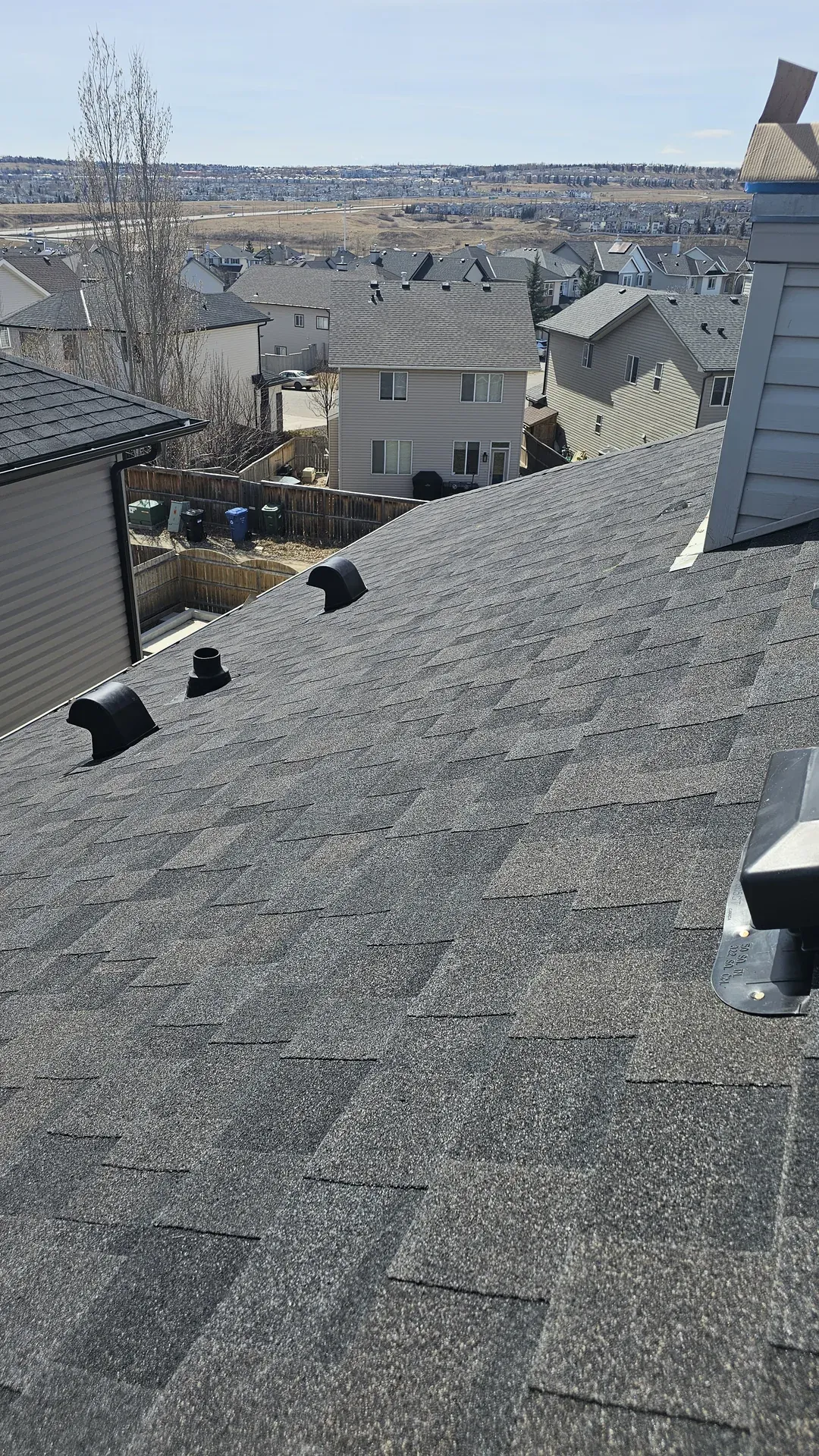
There is a specific kind of ice that Edmonton homeowners learn to recognise: a thick, dirty ridge sitting along the bottom two or three feet of the roof, with icicles hanging off the eavestrough like a row of teeth. Some people think it looks festive. It is actually your roof telling you that heat is escaping your house in the wrong place, and that water is being held on your roof instead of being sent off it.
Ice dams cause more winter leaks in this city than damaged shingles do. Here is exactly what is happening, and what to do about it.
How an ice dam forms
An ice dam needs three ingredients, and Edmonton supplies all three from November through March.
Snow on the roof. A layer of insulating snow, which is why dams often appear after a heavy snowfall rather than during a cold snap on a bare roof.
A warm roof deck in the middle, and a cold one at the edge. Heat escaping from the living space into the attic warms the sheathing over the heated part of the house. The eaves overhang past the exterior wall, so there is no heated space beneath them. Nothing warms them but the sun.
Sub-freezing air. So that any water reaching the cold edge freezes rather than running off.
Put those together and you get a slow machine. Snow on the warm part of the roof melts from underneath. That meltwater runs down the deck under the snowpack, reaches the overhang, hits the cold zone, and refreezes. The next bit of meltwater freezes on top of that. Layer by layer, a dam of solid ice builds along the eave.
Once the dam is tall enough, it stops being a nuisance and starts being a problem. Meltwater arriving from above can no longer get past it, so it backs up behind the ice and sits there. Shingles are designed to shed water flowing downhill, not to hold a standing pool. Water finds its way under the tabs, through the nail holes, and into your soffit, wall cavity, or ceiling.
That is why the classic ice dam leak appears on an interior wall or ceiling a foot or two in from an exterior wall, on a sunny day in January, with no rain in sight.
Why Edmonton is purpose-built for ice dams
Our climate hits the sweet spot almost perfectly. We take roughly 127 centimetres of snow a year, and we keep it: measurable snow cover sits on the ground here for about 133 days in an average winter, so the roof rarely gets a clean sweep between events.
Then there are the swings. A February afternoon that reaches plus two after a week at minus twenty five produces exactly the melt-and-refreeze cycle a dam needs, and we get several of those a season. Cities with steadier winters build less of this ice, and cities with milder winters do not build enough snowpack to matter.
North-facing slopes are the worst offenders because the sun never gets a chance to clear them, and the roof over an attached garage is second, particularly where a heated bonus room sits above it.
What an ice dam actually damages
The icicles are cosmetic. The damage list underneath them is not.
- Water into the wall and ceiling. The most common outcome, and the most expensive, because it soaks insulation and drywall before anyone sees a stain.
- Rotted roof decking and fascia. Repeated saturation at the eave delaminates plywood and rots wood fascia from behind.
- Crushed and torn-off eavestrough. Ice can add hundreds of pounds along a run. Every winter we replace eavestrough that was pulled off its fascia by ice load, taking chunks of the fascia board with it.
- Ruined soffit. Aluminium soffit panels blown out or stained by trapped meltwater, and once water is in the soffit cavity the ventilation path is compromised too.
- Shingle damage. Water freezing under a tab lifts it. Do that for five winters and the shingles at the eave are done well before the rest of the roof.
- Mould in the wall cavity. Slow, invisible, and unpleasant to remediate.
You have one on your roof right now. What do you do?
First, decide whether it is actively leaking. If there is no water coming inside, you have time to do this properly. If there is water coming inside, you need the ice channelled off the roof today, and you should call somebody.
What helps immediately:
- Pull the snow off the lower roof with a roof rake from the ground, working from the eave upward, clearing the bottom three or four feet. No snow above the dam means no more meltwater feeding it. This is the single most effective thing a homeowner can safely do.
- Make a channel through the dam so trapped water can escape. A pair of pantyhose or a long sock filled with calcium chloride, laid vertically across the dam, will slowly melt a drainage channel through it over a day or two.
- Improve the situation inside. Turn the furnace humidifier down, run bath fans, and if you can safely reach the attic hatch, check whether it is sealed.
What to avoid, firmly:
- Do not chip at it with an axe, hammer, or ice pick. We have repaired a lot of roofs where the homeowner did more damage in ten minutes than the ice did in a month. You cannot see the shingles under the ice, and they are brittle at these temperatures.
- Do not use rock salt or sodium chloride. It corrodes aluminium eavestrough, damages metal flashings, and kills whatever is planted below. Calcium chloride or magnesium chloride only.
- Do not use a pressure washer or a torch. People genuinely try both. Neither ends well.
- Do not climb up there in January. Icy roof, cold hands, hard ground. It is not worth it.
The permanent fix, and why it has almost nothing to do with shingles
The reason ice dams keep coming back is that people treat the ice instead of the heat that made it. A roof that stays uniformly cold does not form dams. Getting there involves four things, in this order.
Air sealing the ceiling plane. The biggest source of attic heat is not conducted heat through insulation, it is warm air leaking through gaps: the attic hatch, pot lights, plumbing stacks, top plates of interior walls. Sealing these is the highest-value work available. It is also the same fix that solves attic rain, which is the other half of Edmonton’s winter roof problem.
Restoring soffit intake and balanced ventilation. Alberta code calls for attic ventilation of at least 1/300 of the insulated ceiling area, split about evenly between soffit intake and exhaust near the ridge. The failure we find most often is blow-in insulation that has drifted into the eave and sealed the intake vents shut, which stops the attic from flushing warm air and lets the deck warm up unevenly. Baffles in every rafter bay fix it.
Insulation depth. Alberta’s minimum for attics sits around R-40. In this climate R-50 to R-60 is the sensible number. Add it after the air sealing and the airflow, not before.
Ice and water shield at the eaves. This is the roofing half of the answer. A self-adhering membrane bonded directly to the deck, running from the edge up past the interior wall line, means that when a dam does form, backed-up water hits a waterproof layer instead of a nail hole. It does not prevent ice dams. It prevents ice dams from becoming ceiling stains.
On every roof we replace, ice and water shield goes at every eave, in every valley, and around every penetration, without exception and without it being an upsell line. In this climate treating it as optional is how you get a roof that leaks in year six.
Are heat cables worth it?
Sometimes, as a targeted tool rather than a solution.
Heat cables are reasonable on a stubborn north-facing eave, a valley that dumps onto a low roof, or above a doorway where falling ice is a safety issue, and they are useful on a house where the real fix is genuinely impractical, such as a vaulted ceiling with no attic to work in.
They are a poor substitute for air sealing on a normal house. They cost money to run every winter, they have a service life, and they treat the symptom forever instead of the cause once. If somebody offers heat cables as the whole answer without ever looking in your attic, they are selling you a subscription.
What this costs in Edmonton
- Roof rake, homeowner-purchased: $60 to $150, and worth owning
- Professional steam ice dam removal, emergency: roughly $500 to $1,500 depending on the length of the dam and access
- Rafter baffles and clearing blocked soffit intake: $400 to $1,200
- Attic ventilation upgrades: $300 to $800
- Air sealing the ceiling plane: $500 to $1,500
- Attic insulation top-up to R-50 plus: $1,800 to $4,000
- Eavestrough replacement after ice damage: $1,500 to $2,800 on a bungalow, $2,200 to $4,200 on a two-storey
- Ice and water shield: included in every roof replacement we quote
Note the pattern. The prevention costs a fraction of the repair, and the repair costs a fraction of the water damage.
The short version
Ice dams are a heat problem wearing a roofing costume. Rake the snow off the lower roof, never chip at the ice, and get the attic looked at before next winter rather than during it.
We inspect attics and eaves across Edmonton, Sherwood Park, St. Albert and the surrounding communities, and we will tell you straight whether you need baffles and air sealing or an actual roof. Get in touch and we will get up there and look.
Free Estimate
Want a straight answer on your own roof?
Tell us about your roof and we send you a written quote. No pressure, no scare tactics, and we will tell you when a repair is all you need.
Keep reading
All articles
Attic Rain in Edmonton: Why Your Ceiling Drips in February
Water staining your ceiling after a cold snap breaks is almost never a roof leak. Here is what attic rain is, why Edmonton homes get it, and how to actually fix it.
Read the guide
The Best Shingles for Edmonton Weather: IKO, BP, Malarkey and GAF Compared
Wind ratings, impact class and real Edmonton performance for the four shingle brands we install most, plus the parts of the system that matter more than the brand.
Read the guide
The Best Time of Year to Replace a Roof in Edmonton
Season by season, what actually changes for an Edmonton re-roof: pricing, scheduling, shingle sealing temperatures, and whether winter roofing is a real option.
Read the guide