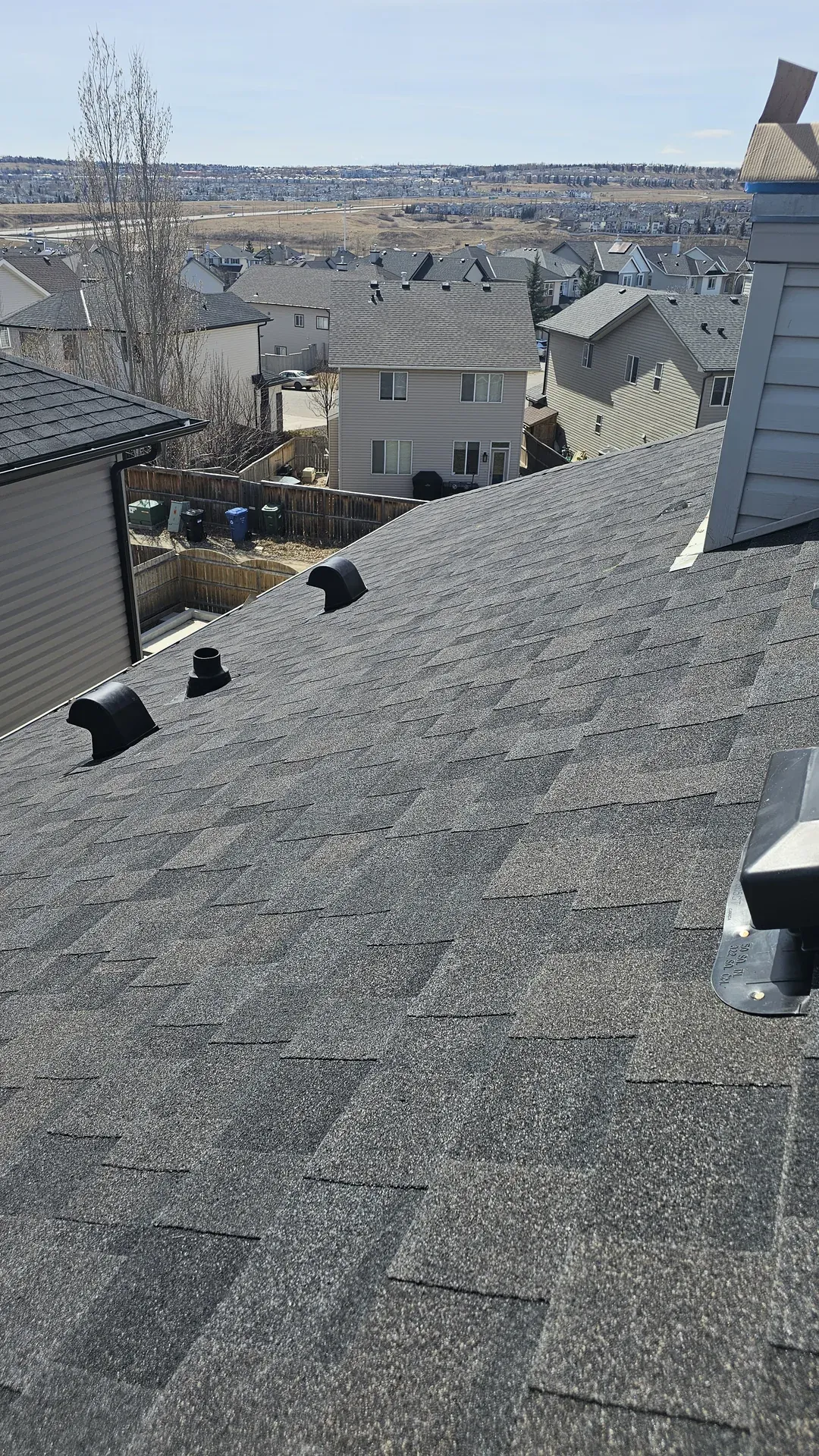
Attic Rain in Edmonton: Why Your Ceiling Drips in February
Water staining your ceiling after a cold snap breaks is almost never a roof leak. Here is what attic rain is, why Edmonton homes get it, and how to actually fix it.
Royal Roofing Edmonton
Edmonton roofing & exteriors since 2011
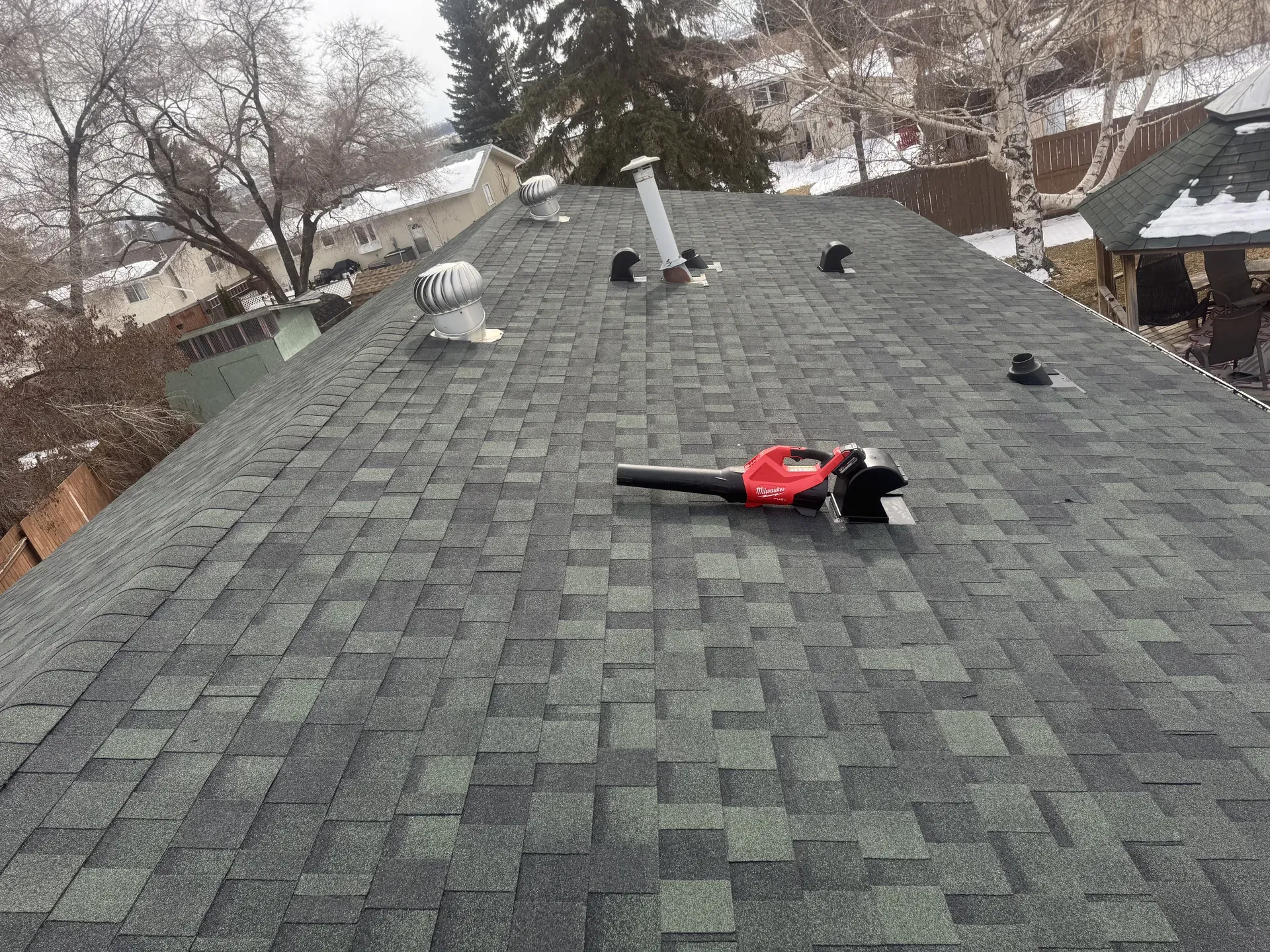
Every February the same phone call comes in. It went to minus thirty for a week, the temperature finally climbed back above freezing, and now there are brown rings on a bedroom ceiling, damp insulation in the attic hatch, or water running down the inside of a wall. The homeowner is certain the roof is leaking.
Almost every time, it isn’t.
What they have is attic rain, and it is one of the most misdiagnosed problems on Edmonton homes. We have watched people spend thousands re-shingling a roof that was working perfectly, only to have the ceiling stain again the following winter. So before you call anyone about a roof, spend five minutes understanding what is actually happening above your ceiling.
What attic rain actually is
Attic rain is condensation, not infiltration. The water was never outside your house. It came from inside it.
Your family produces a remarkable amount of moisture. Showers, cooking, laundry, dishwashers, houseplants, humidifiers, and simple breathing add somewhere in the range of 10 to 20 litres of water vapour to the air in an average home every day. In summer that moisture escapes through open windows and the air outside is warm enough to carry it. In an Edmonton January, with the windows sealed and the outdoor air holding almost no moisture at all, that vapour has nowhere to go but up.
Warm, humid indoor air is buoyant. It finds every gap in the ceiling plane: the attic hatch, pot light housings, plumbing stacks, bathroom fan penetrations, the top plates of interior walls, the gap around a chimney chase. It rises into the attic, hits the underside of a roof deck sitting at minus twenty five, and instantly gives up its moisture as frost.
Nothing happens for weeks. Frost accumulates on the nails, on the sheathing, on the underside of the deck. Then the cold snap breaks, we get one of those forty degree swings Edmonton is famous for, and all of it melts at once. That is your ceiling stain.
Why Edmonton gets this worse than most of Canada
Three things line up here that do not line up in Vancouver or Toronto.
Our cold is long and deep. Edmonton’s January mean sits around minus eleven degrees, and stretches below minus twenty five are routine. That gives frost weeks to build up rather than days. The roof deck in a Sherwood Park attic in mid-January can sit thirty five degrees colder than the air in the bedroom below it.
Our thaws are sudden. A prairie warm front or a chinook ridge can lift us from minus twenty eight to plus four inside forty eight hours. Every gram of accumulated frost melts on roughly the same afternoon. If it had melted gradually the attic ventilation would have carried most of it away as vapour. Instead it becomes liquid water in a hurry.
Our houses are tight. Homes built in Edmonton over the last twenty years are dramatically better sealed than the 1970s bungalows they sit beside. That is good for heating bills and bad for humidity, because the air changes that used to flush moisture out on their own no longer happen. Newer homes in Bremner, Jensen Lakes, Copperhaven and Southfork get attic rain more often than the older stock, not less, and it surprises people every time.
How to tell attic rain from an actual roof leak
Before you spend money, work out which problem you have. The tells are fairly clear.
It is probably attic rain if:
- The staining appears during or right after a thaw, and stops when it gets cold again
- It shows up in multiple, unrelated spots rather than tracking down from one point
- It is worst near the middle of the house, over bathrooms, or near the attic hatch
- You find frost, damp insulation, or water beads on nail tips when you look in the attic on a cold day
- There has been no rain and no significant snowmelt on the roof surface itself
It is probably a genuine roof leak if:
- It shows up during or shortly after rain, at any time of year
- It repeats in the same location every time
- You can trace a path in the attic from a specific penetration, valley, or flashing down to the stain
- There is visible damage above it: lifted or missing shingles, a cracked vent boot, failed step flashing at a wall
If your ceiling stains in July, that is a roof problem, and our roof repair page covers what usually causes it. If it only ever happens in February, no roofer can fix it by touching your shingles.
The four causes, roughly in order of how often we find them
1. Blocked soffit intake
This is the one. Attic ventilation is a system with two halves: cold air in low at the soffits, warm moist air out high at the ridge. Blow-in insulation settles and migrates over the years, drifts toward the eave, packs against the underside of the roof deck, and seals the intake vents shut from the inside. From the ground the soffit looks perfect. From inside the attic there is a wall of fibreglass where the airflow should be.
Once intake is blocked, the exhaust vents cannot pull. The attic stops breathing, and everything you send up there stays up there.
The fix is inexpensive: pull the insulation back off the eave and install rafter baffles (also called insulation stops or proper vents) in every rafter bay so there is a permanent clear channel from soffit to attic. On a typical home this is a few hundred dollars of work that solves more attic moisture problems than anything else on this list.
2. Bathroom fans that do not go outside
We still find bath fans discharging straight into the attic, or into a flex duct that was supposed to reach a roof cap and came off years ago, or venting into the soffit where the humid air simply gets drawn straight back in through the intake vents six inches away.
A bathroom fan should run in a smooth, insulated duct, sloped so condensate drains back toward the fan, terminating at a dedicated roof or wall cap with a damper. Not into the attic. Not into the soffit.
3. Gaps in the air and vapour barrier
Every hole in your ceiling is a chimney for moist air. The usual offenders are the attic hatch (often a bare sheet of plywood with no weatherstrip and no insulation on top), older recessed pot lights, plumbing vent penetrations, and the top plates of interior partition walls where the poly was never properly sealed.
Air sealing the ceiling plane is unglamorous work and it is the single highest-value thing you can do. Sealing the hatch alone, with weatherstripping and a rigid insulation cap, is a Saturday afternoon and often makes a visible difference.
4. Not enough net free vent area
The National Building Code, Alberta Edition, requires attic ventilation of at least 1/300 of the insulated ceiling area in net free vent area, split roughly half as intake at the soffits and half as exhaust at or near the ridge. A 1,500 square foot ceiling therefore needs about 5 square feet of net free vent area, or about 720 square inches, and roughly 360 of those inches need to be intake.
Plenty of Edmonton homes were built to the letter of that requirement and no further, then had insulation topped up, a new bathroom added, and a hot tub installed downstairs. Meeting the minimum is not the same as being adequately ventilated for how the house is actually lived in.
What actually fixes it, in the order we do it
- Get in the attic and look. Not from the hatch with a flashlight. Someone needs to physically go up there, walk the perimeter, and check whether the soffit bays are clear. Half the diagnosis is done in the first ten minutes.
- Clear and baffle the intake. Pull insulation off the eaves, install baffles in every bay, restore the airflow path.
- Fix the exhaust side. Confirm there is enough exhaust and that it is high on the roof. Do not mix passive roof vents with a powered fan or a ridge vent on the same attic space, because the low vents become intake for the high ones and short-circuit the whole system.
- Vent every bathroom and the kitchen range to the exterior, properly ducted and insulated.
- Air seal the ceiling plane. Hatch, pot lights, plumbing stacks, top plates.
- Then, and only then, look at insulation depth. Alberta code minimum for attics is around R-40; for our winters, R-50 to R-60 is the sensible target. But adding insulation before fixing airflow just buries the problem deeper.
- Manage indoor humidity. In a cold snap, target 30 to 35 percent relative humidity indoors, and lower when it is very cold. Turn the furnace humidifier down. Run bath fans for twenty minutes after a shower, not two.
What does not fix it
A new roof. We will say this plainly because it costs people the most money: replacing shingles does nothing for attic rain. If a contractor looks at a February ceiling stain and quotes you a re-roof without going into the attic, get a second opinion.
Heat cables. They melt ice at the eaves. They do nothing about condensation on the deck.
More attic insulation on its own. Helpful, but only after the air is moving and the leaks are sealed. Insulation slows heat, it does not stop vapour.
A dehumidifier in the attic. Yes, people try this. The attic is supposed to be vented to the outdoors.
When the roof genuinely is part of the problem
Sometimes it is a roofing job after all, just not the part people expect.
If the soffit is solid vinyl with no perforations, or the perforated panels were installed over solid sheathing that was never cut open behind them, there is no intake regardless of what the insulation is doing. We see this on re-clad jobs where somebody skipped a step. Fixing that means new soffit and fascia with correctly proportioned vented panels and the blocking opened up behind them.
If the previous roofer installed a ridge vent without opening the deck slot underneath it, or capped off the old vents when adding new ones, the exhaust side is decorative. Both of those are found and corrected during a roof replacement.
And if the attic has been getting soaked every winter for a decade, the sheathing may be delaminated, mould-stained, or soft. At that point the ventilation fix and the roof replacement happen together, because the deck has to come off anyway.
What it costs in Edmonton
Ventilation and air sealing work is usually the cheapest meaningful repair a house gets.
- Rafter baffles and clearing blocked soffit intake: roughly $400 to $1,200 depending on the number of bays and attic access
- Attic ventilation upgrades, added roof vents or a corrected ridge vent: about $300 to $800
- Re-ducting a bathroom fan to a proper exterior cap: $300 to $700 per fan
- Air sealing the ceiling plane, including hatch: $500 to $1,500
- Topping up attic insulation to R-50 or better: $1,800 to $4,000 on a typical bungalow
Compare that to $9,000 to $18,000 for the roof replacement some homeowners get talked into for a problem the roof never had.
The short version
If your ceiling stains in the middle of winter and the roof is dry in the summer, you have a moisture and airflow problem, not a roofing problem. Get someone into the attic before you get anyone onto the roof.
We will do that inspection for free anywhere in the Edmonton region, and we will tell you honestly if the answer is baffles and a bathroom fan rather than a new roof. That has cost us jobs. We would rather keep the reputation. Book a look and we will show you photos of what is actually going on up there.
Free Estimate
Want a straight answer on your own roof?
Tell us about your roof and we send you a written quote. No pressure, no scare tactics, and we will tell you when a repair is all you need.
Keep reading
All articles
The Best Shingles for Edmonton Weather: IKO, BP, Malarkey and GAF Compared
Wind ratings, impact class and real Edmonton performance for the four shingle brands we install most, plus the parts of the system that matter more than the brand.
Read the guide
The Best Time of Year to Replace a Roof in Edmonton
Season by season, what actually changes for an Edmonton re-roof: pricing, scheduling, shingle sealing temperatures, and whether winter roofing is a real option.
Read the guide
How Long Does a Roof Last in Edmonton? (And How to Tell Yours Is Done)
Real service life for asphalt, metal and cedar on Edmonton homes, why the number on the wrapper is not the number you get, and the signs it is time to replace.
Read the guide